Big Feelings
I Yelled at My Toddler and I Feel Awful — Now What?

By Dao, Founder · PhD in mathematics, former Director of Data Science at Uber and Capital One · LinkedIn ↗
The short version
- You’re in the biggest club there is: in one national survey, about nine in ten parents said they’d used harsh words at some point. The yell doesn’t define you. What you do next does.
- Even great parent-child pairs are in sync only about a third of the time (Ed Tronick’s research). Security comes from repair — going from mismatch back to match — not from never missing.
- The repair is simple: wait for calm, then name it, own it, and say what you’ll try next time. No “I’m sorry, but…” — the “but” cancels the sorry.
- Watch the pattern, not the moment. One yell followed by warm repair is a normal Tuesday. Yelling as the daily weather is worth changing — and there’s a gentler way to be heard.
First: the guilt you feel is not proof you’re a bad parent. It’s proof you’re a good one — guilt is the feeling that pushes us to fix things. And this is fixable. Researchers who study parents and kids found something freeing: even the healthiest pairs are in tune only about a third of the time. What builds a secure kid isn’t a home with no hard moments. It’s a home where hard moments get repaired. So take a breath, wait until you’re both calm, and do the repair: name what happened, own it without a “but,” and say what you’ll try next time. That’s it. Ten minutes from now, this can be a moment that taught your child the most useful lesson there is — things break, and we fix them.
If you’re reading this tonight with a lump in your throat — come here. Every parent yells. Every single one. About nine in ten parents in a national survey admitted to harsh words with their kids at some point. That doesn’t make it your goal. But it makes you human, not a monster. And here’s the part nobody tells you in the guilt spiral: the researchers who study this stuff don’t measure good parenting by the absence of hard moments. They measure it by what happens after. That part is still ahead of you. Let’s do it well.
Part of our guide to social-emotional skills by age.
If your child is 1 or 2: your tone said it all — so let your warmth say the rest
They won’t remember the words. They felt the storm — and they’ll feel the sunshine come back.
A toddler this young doesn’t process a lecture, and won’t recall the sentence you regret. What they registered was the sudden thunder — a big voice from their favorite person. That’s why the wet eyes. It’s also why repair at this age barely needs words. Researchers found everyday mismatches between parents and babies get repaired constantly — most within seconds — and each repair quietly teaches the baby: we can fix this. [1, 2]
Try this: Get low, open your arms, and let your face and voice do the repairing. Soft eyes. Gentle voice. A cuddle and a simple “Mama’s sorry. Big voice is all done. I love you.” Then a few minutes of doing something together — blocks, a book, a snack. Reconnection is the apology they can understand.
If your child is 3 or 4: a short, honest apology — no “but”
Old enough to hear a real sorry. Young enough that it must be short.
By three or four, your child understands an apology — and they’re watching how you make one. This is actually the good news hiding in the bad moment: kids learn to repair by watching us repair. Experts across the board land on the same short script. The AAP’s version: cool down first, apologize, and say how you’ll handle it next time. Dr. Becky Kennedy’s version has three steps: name what happened, take responsibility, share what you’ll do differently. [6, 12, 9, 8]
Try this: Wait until you’re both calm — an apology delivered mid-storm doesn’t land. Then keep it small and clean: “I’m sorry I yelled. You didn’t deserve a big voice. Next time I’m going to take a dragon breath first.” One warning from the pros: don’t let the apology grow a tail. “I’m sorry I yelled, but you wouldn’t listen” isn’t an apology — it’s a receipt. Own your half only. Their behavior can be tomorrow’s conversation.
If your child is 5 or 6: repair out loud, and invite their feelings in
Now the apology can become a conversation — and a masterclass.
A five- or six-year-old can tell you how the yell felt — and letting them say it is part of the repair. Researchers who watched parents and preschoolers work through hard moments found that pairs who repaired well had kids with fewer behavior struggles and better self-control months later. And the Gottman Institute puts it beautifully: admitting a mistake to your child is a gift. They learn that mistakes are fixable, and that people can be loved without being perfect. [3, 13]
Try this: Make the repair a two-way street: “I’m sorry I yelled this morning. That probably felt scary. How did it feel to you?” Then listen without defending. Close with the plan: “Next time I feel that mad, I’m going to say ‘I need a minute’ and get calm first.” You’ve just modeled the entire skill of repairing a relationship — the one they’ll use on the playground this week and in their marriage someday.
The repair, step by step — and the guilt, handled
- Calm yourself first. An apology from a still-boiling parent comes out wrong. Step away, breathe, splash water on your face. The repair works better in ten minutes than in ten seconds. [6]
- Name it, own it, plan it. “I yelled. I’m sorry — that wasn’t okay. Next time I’ll take a breath first.” Three sentences. That’s the whole repair. Every expert version — AAP, Child Mind, Dr. Becky — is a variation of these three moves. [6, 8, 12]
- Kill the “but.” “I’m sorry, but you made me…” hands your child the blame for your voice. Own your half fully. Dr. Laura Markham’s warning: most of us start to apologize, then veer into excusing ourselves. Notice the swerve and stop it. [9]
- Reconnect in their language. After the words, do something warm together — a book on your lap, a snack side by side. ZERO TO THREE calls repair the thing that restores the tie. For a small child, togetherness is the proof. [4]
- Turn the guilt into fuel — and drop the shame. Psychologists draw a bright line: guilt says “I did a bad thing” and pushes us to fix it. Shame says “I am bad” and pushes us to hide. Guilt is useful tonight; shame is not. Talk to yourself the way you’d talk to a friend who yelled — parents who manage that are calmer with their kids next time, not more careless. [10, 11]
- Watch the pattern, not the moment. Here’s the honest line: one yell, repaired, is a normal Tuesday in a warm home. But research is clear that harsh words as the daily pattern hurt kids — even in loving families. If the yelling is becoming the weather, shrink the mornings, lower the asks, and get support. And if you want fewer standoffs that lead to yelling, start where they start: with being heard the first time. [7, 15, 6]
See the repair story — starring your family

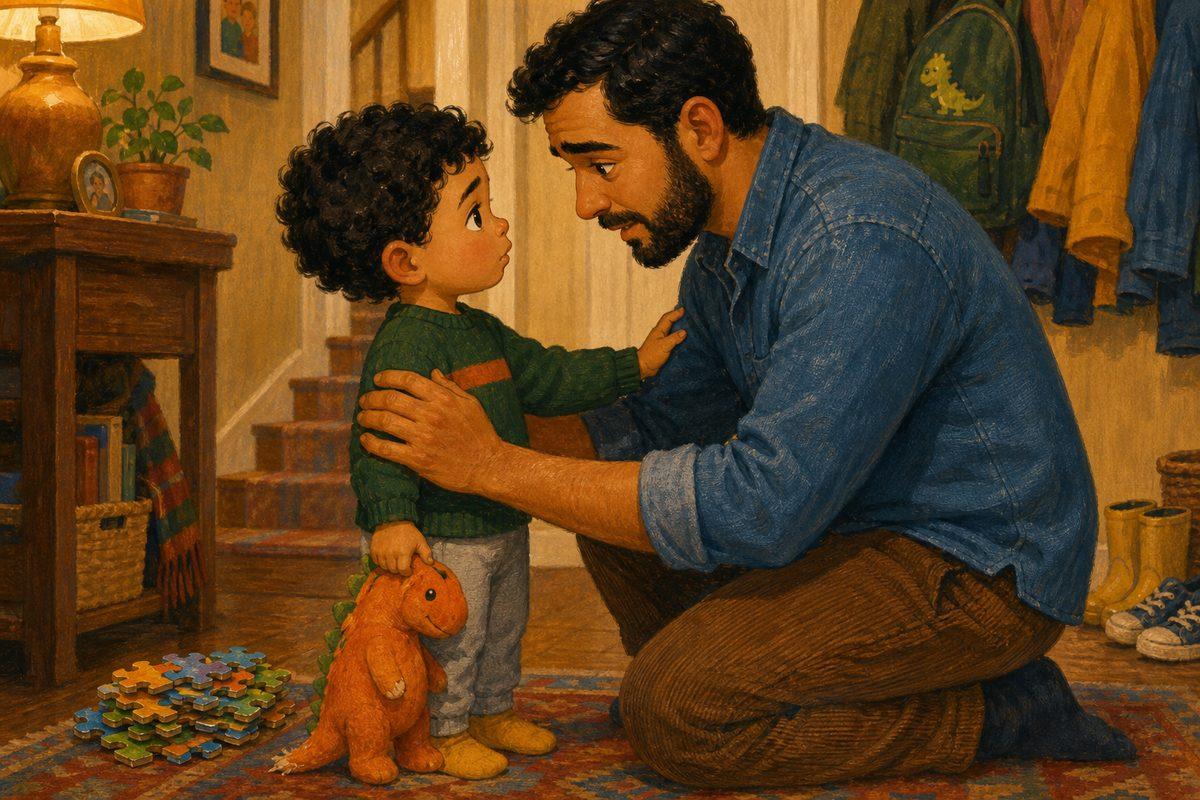

What this story is built to help with: What repair looks like from a child’s eye level: the big feeling, the brave sorry, and the warm coming-back-together — rehearsed on the calmest lap in the house.
Why a book where your child is the hero helps the repair stick
Here’s what Tronick’s research really hands us: kids don’t need perfect parents. They need a thick history of repairs — hundreds of small proofs that after the storm, we find each other again. A bedtime story is the easiest repair rep there is. It’s warmth, closeness, and your voice at its gentlest, at the exact end of a day that had a hard moment in it. [1, 2]
And a story where your child is the hero — where the kid with their name and face feels a big feeling, hears a brave sorry, and lands in a warm hug — lets your family rehearse repair when nobody’s upset. The next hard moment comes pre-loaded with a script you’ve read together twenty times: things break, people say sorry, love comes back. The book plus you is what makes it land. [14]

Quick answers
Will my toddler remember me yelling?
Almost certainly not the moment itself — early childhood memories don’t work that way. What sticks is the pattern: the overall feel of life with you. One repaired yell dissolves into a thousand warm moments. That’s exactly why the repair matters more than the slip: it decides what the moment becomes.
I yelled and my child looked scared. What do I do right now?
Go back in — calm first. Get low, soften your face and voice, and keep it simple: “That was a big scary voice. I’m sorry. You’re safe. I love you.” Then reconnect with something warm and ordinary — a cuddle, a book, a snack together. A scared look in the moment is your child reading your storm, not a mark that stays. Repair is how it lifts.
Why do I only get listened to when I yell?
Because the yell has become the signal that you mean it — kids tune out everything below the volume that gets enforced. The way back isn’t more volume. It’s delivering the ask up close, calmly, once, and then following through. We wrote a whole guide to being heard without yelling — that’s the long-term fix for the moments that lead here.
Is yelling ever abuse? When should I worry about myself?
There’s an honest line here. Occasional yelling followed by repair happens in nearly every warm home. But research links a steady pattern of harsh verbal discipline — yelling, insults, put-downs as the norm — to real harm, even when parents are loving otherwise. Words that attack who your child is (“you’re worthless,” “I wish you weren’t here”) are different from a loud “STOP!” — and if that’s where anger takes you, or you can’t pull out of the pattern, talk to your doctor or a therapist. Asking for help with your own big feelings is the strongest parenting move there is.
Should I apologize to my toddler even if they were misbehaving?
Yes — for your half. Your child’s behavior may have needed a boundary; your delivery is a separate thing, and the apology covers only that. “I’m sorry I yelled” and “we still don’t throw trucks” can live in the same conversation. Kids learn boundaries best from a parent they’re not braced against — and they learn how to apologize by watching you do it. (Wondering about the other direction — making them say sorry? We wrote about that too.)
Who’s behind this
I’m Dao — a mom, and the founder of PlotJoys. I’ve had the hallway moment: the too-big voice, the wet eyes, the guilt that eats the rest of the evening. What changed things for me wasn’t becoming a parent who never breaks. It was learning to repair — and finding that the coming-back-together can be the warmest part of the day. That’s why our books end the way they do.
Tell us the moment in a sentence or two, add a photo, and see them drawn as the hero.
Keep reading
The research, if you want it
- Tronick & Beeghly (via PMC) — “Infants’ Meaning-Making and the Development of Mental Health Problems” (the messy-by-design interaction; ~70% of mismatches repaired in the next step)
- Norland College Journal — interview with Professor Edward Tronick (parent and child “in sync” only ~30% of the time; repair builds trust)
- Kemp, Lunkenheimer et al., Family Relations (via PMC) — “Can We Fix This? Parent–Child Repair Processes and Preschoolers’ Regulatory Skills”
- ZERO TO THREE — “Early Childhood Attachment Styles” (intentional repair restores emotional ties)
- ZERO TO THREE — “Buzzwords Explained: What is Gentle Parenting” (every adult loses their temper; apology models repair)
- HealthyChildren.org (American Academy of Pediatrics) — “What’s the Best Way to Discipline My Child?” (cool down → apologize → say what you’ll do next time; harsh verbal discipline ineffective and harmful)
- Wang & Kenny, Child Development (via PMC) — harsh verbal discipline study; ~90% of US parents report at least one instance (Straus & Field 2003); warmth did not buffer the pattern’s effects
- Child Mind Institute — “Calm Voices, Calmer Kids” (the tune-out effect; the post-yell apology script)
- Dr. Laura Markham, Psychology Today — “How (and When) to Apologize to Your Child”
- Nikolić et al., Scientific Reports (via PMC) — guilt drives repair; shame drives hiding
- Lathren, Bluth & Zvara (via PMC) — parent self-compassion, calmer responses, and less shame after parenting mistakes
- Good Inside (Dr. Becky Kennedy) — “How to Stop Yelling at Your Kids” (every parent yells; the three-step repair)
- The Gottman Institute — “Emotional Intelligence Creates Loving and Supportive Parenting” (admitting a mistake teaches a child they can be loved without being perfect)
- ZERO TO THREE — “Positive Parenting” (great parenting = repair, not perfection)
- The Generation R Study (via PMC) — harsh discipline measured at age three and later emotional/behavioral problems