Toddler Behavior
Why Your Toddler Won’t Listen (and How to Be Heard Without Yelling)

By Dao, Founder · PhD in mathematics, former Director of Data Science at Uber and Capital One · LinkedIn ↗
The short version
- A toddler who “won’t listen” is almost always a toddler who can’t yet — the brain’s braking system (stop the impulse, switch gears) only starts developing around 3½–4. It’s biology, not disrespect.
- The expectation gap is real: in a national survey, over half of parents expected impulse control before age 3 — years ahead of the science. Recalibrating the expectation is half the fix.
- What works: connect before you direct (close, eye level, their name), one ask at a time phrased as a statement, say what to do, give transitions a countdown, wait a beat after you ask — and praise the listening you do get.
- Yelling works less the more it’s used — kids tune out everything below the yell. A story where your child is the hero who turns on their “listening ears” installs the cue at the calmest moment of the day instead.
Here’s the reframe that changes everything: your toddler isn’t ignoring you to defy you. The part of the brain that stops an impulse and switches gears is still under construction — those skills only start developing around age 3½ to 4. Your child hears you; they can’t always brake for you. So the fix isn’t more volume (a yell mostly teaches a toddler to tune out everything below a yell) — it’s connection before direction: get close, get to eye level, say their name, give one small ask. And make “listening ears on” a game you play together, not a battle you lose.
First, exhale. If you’re reading this at 9pm after a shouty bathtime, you’re in the biggest club there is — in one national survey, about nine in ten parents said they’d used harsh words with their kids at some point. You’re not a bad parent, and your child isn’t broken, spoiled, or “manipulating you.” A toddler who doesn’t listen is almost always a toddler who can’t yet — not one who won’t. Here’s the difference, age by age, and the calmer way to be heard.
Part of our guide to social-emotional skills by age.
Your 2-year-old: hears everything, brakes on backorder
They understand far more than they can say — and control far less than they understand.
A 2-year-old’s understanding races ahead of their talking: they get most of what you say, even if they can only say fifty-ish words back. But “gets it” isn’t “can do it.” One-step directions land (“bring me the cup”), while two-step ones (“pick up the ball and bring it to Daddy”) are only just emerging — most kids don’t follow them reliably until around two and a half. And the AAP is honest about the other half: at this age they “just don’t have much control over their emotional impulses,” and testing limits is what 2-year-olds do — it’s the job description of the age, not disobedience. [5, 4, 16, 3, 9]
Try this: Go close instead of loud: same room, crouch to their level, say their name, wait for their eyes. Then one tiny ask, phrased as a statement — “Can you put your shoes on?” politely offers the option to refuse, and they will take it. “Time for shoes. Sit here with me.” works better. Point at the shoes, help them start, and expect to repeat the whole ritual more times than feels reasonable — that’s the age, not your failure.
Your 3-year-old: big vocabulary, tiny brakes
Three is the great mismatch — they talk like they should follow through, and can’t yet.
By three there are 200-plus words and real back-and-forth conversations — so it feels like they should be able to stop and comply. But the braking system is years behind the vocabulary: brain research shows self-control skills only start developing between 3½ and 4, and Harvard’s researchers put it plainly — at three, the capacities to resist distraction and hold your rule in mind “remain relatively limited.” It’s also why your 3-year-old can recite the rule perfectly and still break it: repeating a rule and being able to follow it are two different skills. [4, 2, 8, 1, 10, 11]
Try this: Give endings a runway: a heads-up at five minutes, again at two, again at one — the countdown works because it lets their brain finish and switch gears, not because it’s magic. Turn must-dos into games (cleanup as turn-taking beats cleanup as standoff). And catch them listening: “You came the first time I called — that helped so much!” Your attention is the most powerful tool you have; spend it on the behavior you want more of.
Your 4-year-old: three-part commands — on a good day
Comprehension is nearly there. The follow-through still needs years of practice.
Following a three-part command finally makes the milestone list at 3 to 4, and by 4 to 5 kids can handle genuinely complex directions. So a 4-year-old who won’t get ready usually isn’t missing comprehension anymore — they’re missing momentum, and the brakes still aren’t finished: even at five, self-control skills are “just emerging” and need considerable practice. If your 4-year-old listens beautifully at preschool and ignores you at home, that’s structure doing the work there — not proof they could “listen if they wanted to” here. [6, 18, 8, 13, 9]
Try this: Say it once, calmly — then wait a few seconds without repeating. Instant re-repeating quietly teaches kids that round one is skippable. Keep it to one ask at a time even though they can technically chain three — tired mornings run on toddler attention spans. And when they don’t move: don’t re-run it louder. Walk over, stay warm and firm, and help them start.
How to be heard — without raising your voice
- Connect before you direct. The CDC’s first step for giving directions isn’t about the words at all: move close, make eye contact, say their name, get down face-to-face. A direction shouted from the kitchen is weather; a direction delivered at eye level is a conversation. Their bigger point says the quiet part out loud — “a positive relationship is your most important tool for getting your child to listen.” Connection isn’t the soft option; it’s the mechanism. [9]
- One ask at a time. Toddler attention spans are short, and stacked instructions (“shoes on, coat off the hook, meet me at the door”) overwhelm the system so that nothing gets done. One step. Then the next step. [9, 4]
- Say what TO do — as a statement. “Stop running!” names the problem; “Please walk in the house” names the solution. And skip the question mark: “Can you put your shoes on?” hands a toddler a built-in option to say no — which they will accept. [9]
- Give endings a countdown. Most “not listening” is really “not stopping” — leaving play is a hard gear-change for a brain still building its brakes. A warning at five minutes, then two, then one gives the gear-change a runway. [10, 8]
- Make it a game. “Turns” is a toddler’s home language: take turns putting toys back on the shelf, race the cleanup song to the shoe rack. Playful beats loud, every time it matters. [10]
- Say it once — then wait. After the ask, pause a few seconds before doing anything else. Kids learn to listen to calm instructions given once — or they learn that the first three rounds are ignorable, depending on which one we rehearse with them. If nothing happens, don’t repeat it louder: go close and help them start, in a firm, calm voice. [13, 9]
- Notice the listening you DO get. “You came right away — thank you!” The AAP calls your attention the most powerful discipline tool there is. Point it at the successes and the good tries, and you’ll get more of them. [11]
See the “listening ears” story — starring your child
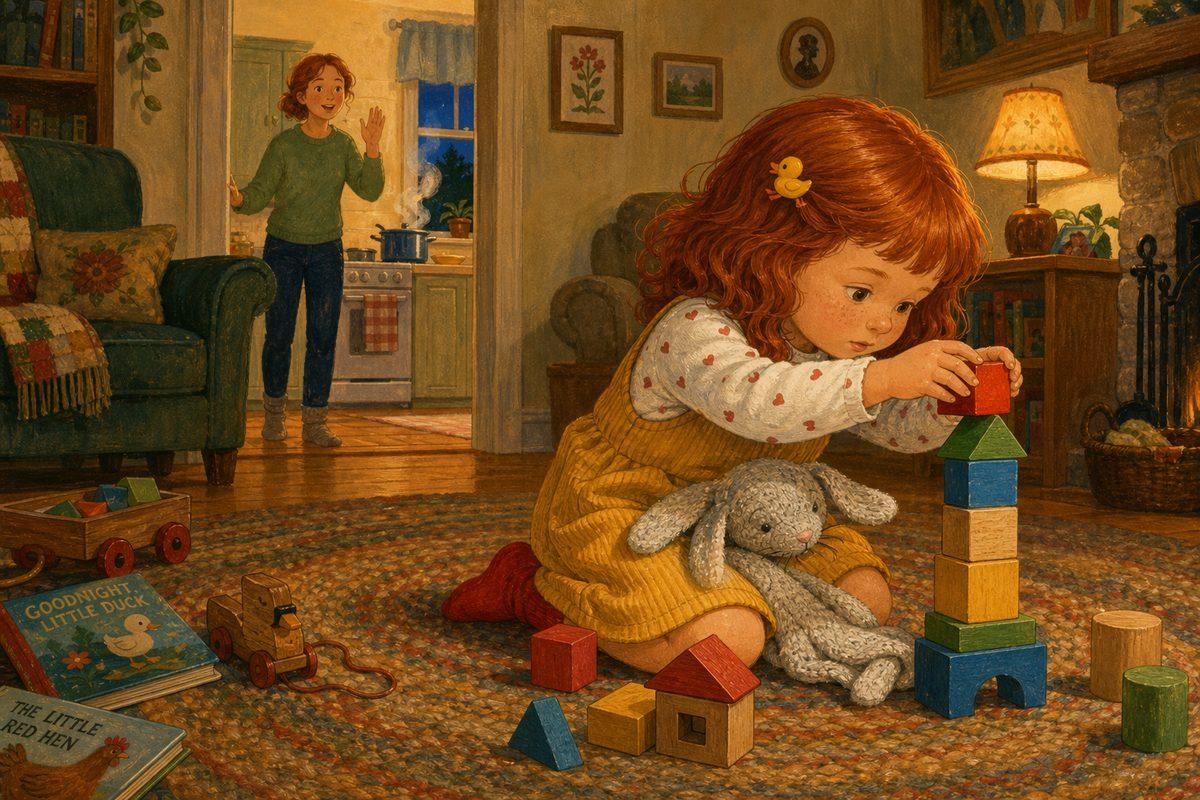
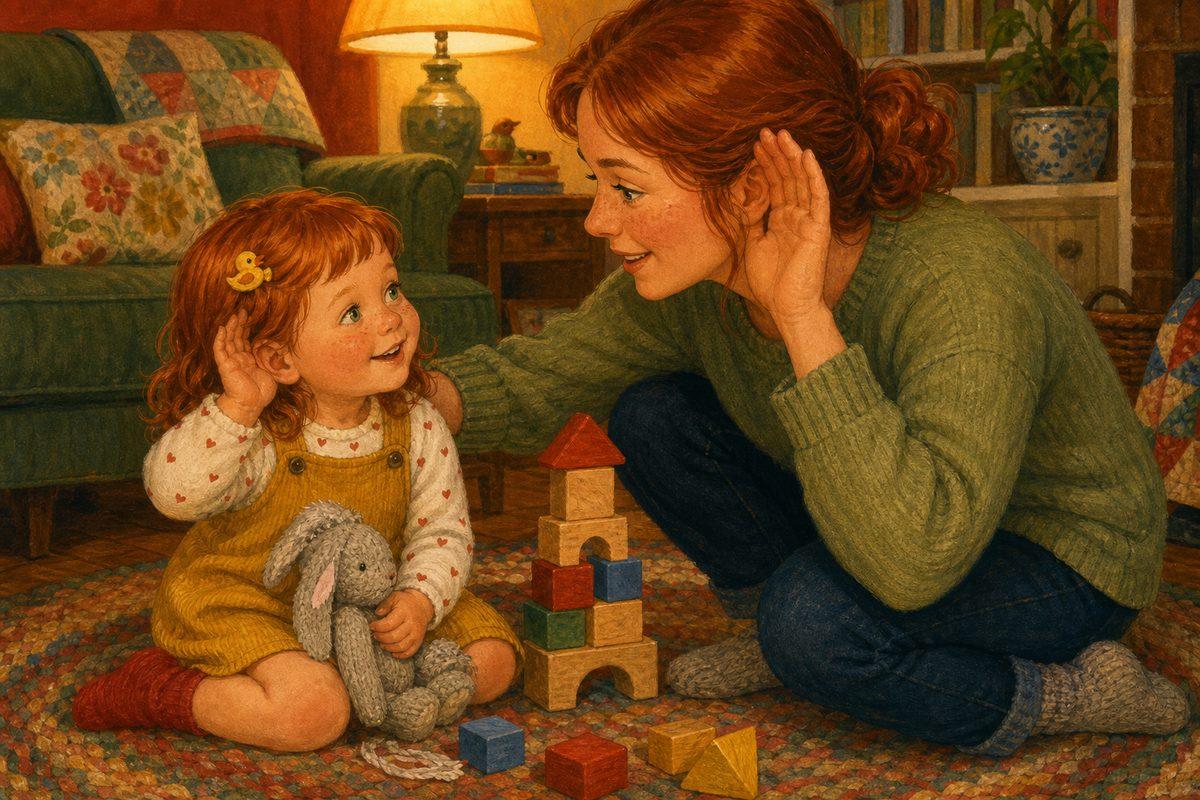

What this story is built to help with: Tuning in, stopping and switching gears, and the “listening ears on” cue — connection-first listening your child can rehearse as the hero of the story.
Why a book where your child is the hero helps them listen
Here’s the catch in every listening tip ever written: you can’t teach a mid-standoff brain anything. The skills behind “listening the first time” — pausing an impulse, switching gears, holding your words in mind — are built through practice in calm moments, with an adult scaffolding the way: routines, cues, one small step at a time. That’s exactly what a bedtime story is — rehearsal, disguised as a cuddle. A story about a kid who turns their listening ears on hands your child the tool before the moment that needs it, and hands you a cue that isn’t a raised voice: “listening ears on!” is a game; “HOW many times have I said—” is not. [7, 8]
Now make the hero your child. When the kid in the pictures has your child’s name and face — feels the pull of the blocks, tries the listening ears, and gets scooped into the warm win — the rehearsal gets personal, and the cue comes pre-loaded with a happy ending you’ve read together twenty times. The research keeps pointing the same direction: warm, connection-first parenting is linked with stronger self-control growth in exactly these years, and the CDC calls the relationship itself “your most important tool” for a child who listens. Twenty minutes on the couch with a book where they’re the hero is both of those at once — the book plus you is what makes it land. [15, 9]
Quick answers
Is it normal for a 2- or 3-year-old to not listen?
Completely — and most of us expect too much, too early. In a national ZERO TO THREE survey, more than half of parents believed toddlers can control impulses before age 3, but brain research shows that skill only starts developing around 3½ to 4 and takes years to become consistent. A 2- or 3-year-old who doesn’t listen is on schedule. The expectations were early; the child isn’t late.
Why does my toddler only listen when I yell?
Because the yell has become the signal that you mean it. Clinicians note that when yelling is frequent, kids tune out everything below it — and the volume itself drowns out what you’re actually saying. The way back: deliver the ask up close, calmly, once — then follow through by going over and helping them start, so the quiet voice means it the way the yell used to. Give it a couple of consistent weeks; the calm ask becomes the new signal.
Will yelling hurt my toddler? I feel terrible after.
Take a breath: nearly every parent yells sometimes, and one hard evening doesn’t undo a thousand warm ones. What the research cautions against is the pattern — the AAP finds harsh verbal discipline ineffective and harmful, and a large study that measured it at age three linked it with more emotional and behavioral struggles later, even in otherwise loving homes. If yelling is becoming the default, treat that as a signal to shrink the system (smaller asks, closer delivery, more runway), not as proof you’re a bad parent. And when you do yell — repair. A hug and “I’m sorry I yelled. I love you.” models the exact skill you’re trying to teach.
How do I discipline a toddler who won’t listen?
Reframe the word: for a toddler, the discipline that works is teaching, not punishing. Keep asks small, close, and calm; follow through the same way every time; and aim your attention — the AAP’s “most powerful tool” — at the listening you want more of. A consequence can’t install a skill the brain hasn’t built yet. Practice and connection are what build it.
My toddler listens at daycare but not at home — why?
Frustrating, and completely common. Daycare runs on scaffolding: predictable routines, songs that signal every transition, and a room full of kids all doing the next thing together. Home has fewer cues and more safety — you’re the person they can fall apart with, which is a compliment wearing a disguise. Borrow the scaffolding (a cleanup song, a countdown, the same order every evening) instead of matching daycare’s structure with volume. Home can be the softest place they have and still be a place where listening happens.
Who’s behind this
I’m Dao — a mom, and the founder of PlotJoys. I make personalized storybooks where your child is the named, illustrated hero, because the skills we most want our kids to learn — listening, calming, kindness — are built in warm moments, not loud ones. A story where a kid just like yours finds their listening ears is the gentlest rehearsal I know. That’s the quiet magic of a book made just for them.
Tell us the moment in a sentence or two, add a photo, and see them drawn as the hero.
Keep reading
- I yelled at my toddler and I feel awful — now what?
- The child who lives in her own little world: daydreamers, dawdlers, and no sense of time
- How to stop toddler whining (what’s normal, what helps)
- The emotional 3-year-old: why the big feelings, and what helps
- Social-emotional skills by age: what to expect from 2–5
The research, if you want it
- ZERO TO THREE — “Toddlers and Self-Control: A Survival Guide for Parents”
- ZERO TO THREE — “Parent Survey Reveals Expectation Gap for Parents of Young Children”
- HealthyChildren.org (American Academy of Pediatrics) — “Emotional Development: 2 Year Olds”
- Nemours KidsHealth — “Communication and Your 2- to 3-Year-Old”
- HealthyChildren.org (AAP) — “Language Development: 2 Year Olds”
- HealthyChildren.org (AAP) — “Developmental Milestones: 3 to 4 Year Olds”
- Harvard Center on the Developing Child — “InBrief: Executive Function: Skills for Life and Learning”
- Harvard Center on the Developing Child — Working Paper 11, “Building the Brain’s ‘Air Traffic Control’ System”
- CDC Essentials for Parenting Toddlers and Preschoolers — “Tips for Giving Directions”
- ZERO TO THREE — “Limits for Little Ones: Setting Boundaries with Toddlers”
- HealthyChildren.org (AAP) — “What’s the Best Way to Discipline My Child?”
- Child Mind Institute — “Calm Voices, Calmer Kids”
- Child Mind Institute — “How to Give Kids Effective Instructions”
- The Generation R Study (via PMC) — harsh parental discipline measured at age 3 and children’s emotional & behavioral problems
- Geeraerts et al., Child Development (via PMC) — “Inhibitory Control Across the Preschool Years” (parenting & self-control growth)
- MedlinePlus (NIH) — “Developmental milestones record: 2 years”
- Wang & Kenny (2014), Child Development (via PMC) — harsh verbal discipline; ~90% prevalence (Straus & Field 2003); warmth did not buffer
- Nemours KidsHealth — “Communication and Your 4- to 5-Year-Old”