Starting School
First Day of Preschool Books: The Ones That Actually Help

By Dao, Founder · PhD in mathematics, former Director of Data Science at Uber and Capital One · LinkedIn ↗
The short version
- Don’t collect all ten — match the book to your child’s worry: the goodbye, the jitters, the missing-you, or the what-happens-there unknown.
- The reading method matters as much as the book: read in the weeks before (not the night of a meltdown), talk about how the characters feel, then ask how she feels.
- These books work as rehearsal — a character walks through the scary thing and comes out okay, so the real morning arrives already familiar.
- The deepest version of that rehearsal is a story where the brave character is your child — name, face, and their own first day.
The short version, because the first day is coming fast: “The Kissing Hand” for the goodbye itself, “Llama Llama Misses Mama” for the missing-you wave that hits after you leave, “The Night Before Preschool” for the jitters at bedtime, “Wemberly Worried” for the child who narrates every worry out loud, and “Owl Babies” for the one lesson under all of it — grown-ups come back. Below: each book matched to the problem it actually fixes, how to read them so the rehearsal works, a kindergarten section, and the version where the hero is your own child.
How to use these books (this part matters more than the list)
Every expert list of first-day advice includes “read books about starting school” — the AAP puts it on its preparing-for-child-care checklist, and child-development experts recommend choosing several to share over the weeks before school starts. But the method is the active ingredient: talk about the story and how the characters are feeling, then ask how your child is feeling. Books about starting school give kids a way to talk through fears they can’t yet raise on their own — the character does the worrying first, and your child gets to watch it turn out okay. [3, 1, 2]
The classics — matched to what they fix
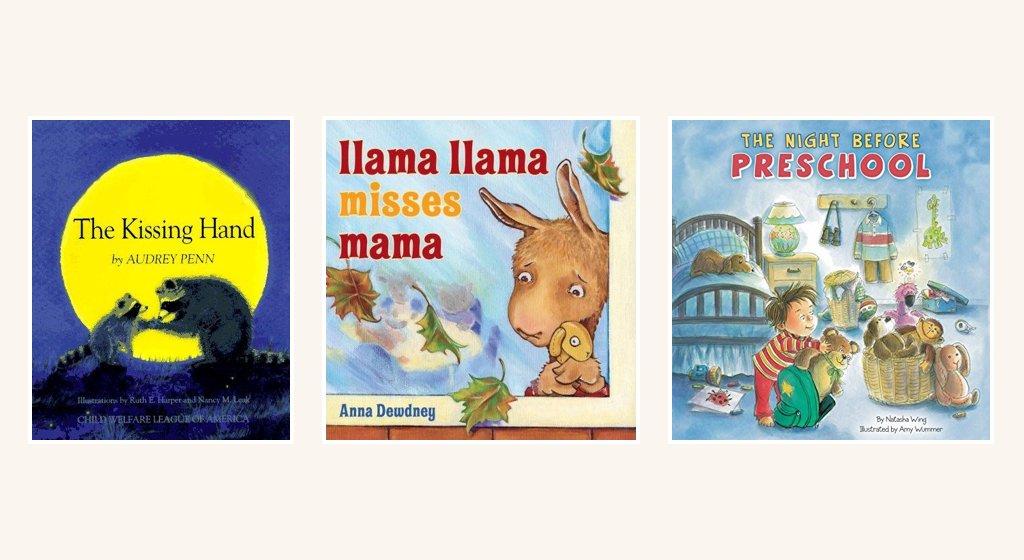
“The Kissing Hand” by Audrey Penn (ages 3–7) — for the goodbye itself. Chester Raccoon doesn’t want to leave his mother for his first night of school, so she kisses his palm — a kiss he can press to his cheek all day whenever he feels alone. It hands you a concrete, repeatable drop-off ritual your child literally carries into the classroom, which is why kindergarten teachers famously reach for it on day one (and why PBS features it as a read-aloud). [5, 6]
“Llama Llama Misses Mama” by Anna Dewdney (ages 2–5) — for the wave of missing-you that hits after you leave. Llama Llama’s first day starts fine, wobbles hard the moment Mama goes to work, and recovers through play — the exact emotional arc of a real drop-off, rehearsed safely at home. The short rhyming text works even for the youngest, and Vanderbilt’s early-learning center publishes a whole teaching guide around it. [7, 8]
“The Night Before Preschool” by Natasha Wing (ages 3–5) — for the night-before jitters. Billy is too nervous to sleep before day one — and too excited to sleep after it. Told in the sing-song rhythm of “The Night Before Christmas,” it’s the natural bedtime read the evening before, and its mirror-image ending quietly reframes nerves as anticipation. [9]
For the worrier
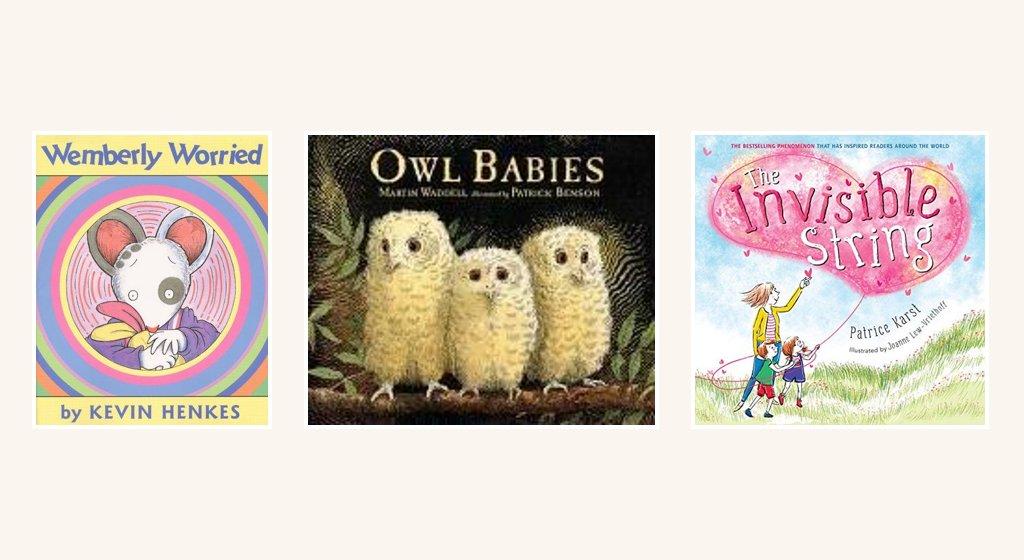
“Wemberly Worried” by Kevin Henkes (ages 4–7) — for the child who narrates every worry out loud. Wemberly worries about everything, and starting school is the biggest one yet; on the first day she meets one friend, and the worries shrink. It validates the whole catalog of what-ifs without dismissing a single one — an ALA Notable Children’s Book with a realistic fix: one friend, one okay day. [12, 13]
“Owl Babies” by Martin Waddell (toddler–preschool) — for the one lesson underneath it all: grown-ups come back. Three baby owls wake to find their mother gone, wait through the worry, and she returns — the drop-off moment in story form, gentle enough for the youngest. Child psychotherapists recommend it for exactly this kind of ordinary separation feeling. [10, 11]
“The Invisible String” by Patrice Karst (ages 4–8) — for the child who needs something to hold onto mid-day. Everyone who loves each other is connected by an invisible string that never breaks, no matter the distance — a portable image a preschooler can carry through the school day, widely used by parents and therapists for separation worries. [14]
“Daniel Goes to School” (Daniel Tiger, adapted by Becky Friedman) (ages 2–5) — for the child who needs a script. Daniel is upset his dad can’t stay; Teacher Harriet teaches him the line “grown-ups come back.” If your child already knows Daniel Tiger, that phrase becomes a ready-made mantra for the classroom door. [16]
For building excitement instead
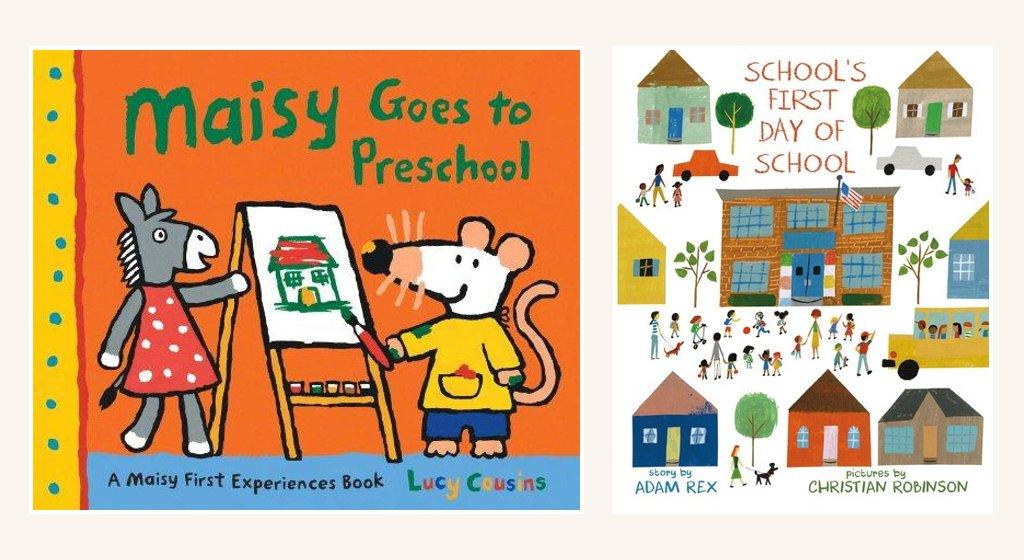
“Maisy Goes to Preschool” by Lucy Cousins (ages 2–5) — for the child whose worry is really the unknown. Maisy simply has a wonderful, ordinary preschool day — the coat peg, painting, snack, nap, playground — so the shape of the day becomes predictable before it ever happens. Calm, bright, and reassuring for the youngest starters. [15]
“School’s First Day of School” by Adam Rex (ages 4–8) — the perspective flip: the brand-new school building itself is nervous about the children coming. It normalizes the jitters with humor and lets an anxious child feel like the brave one for once — a Reading Rockets pick for school-readiness lists. [17, 18]
Starting kindergarten instead?
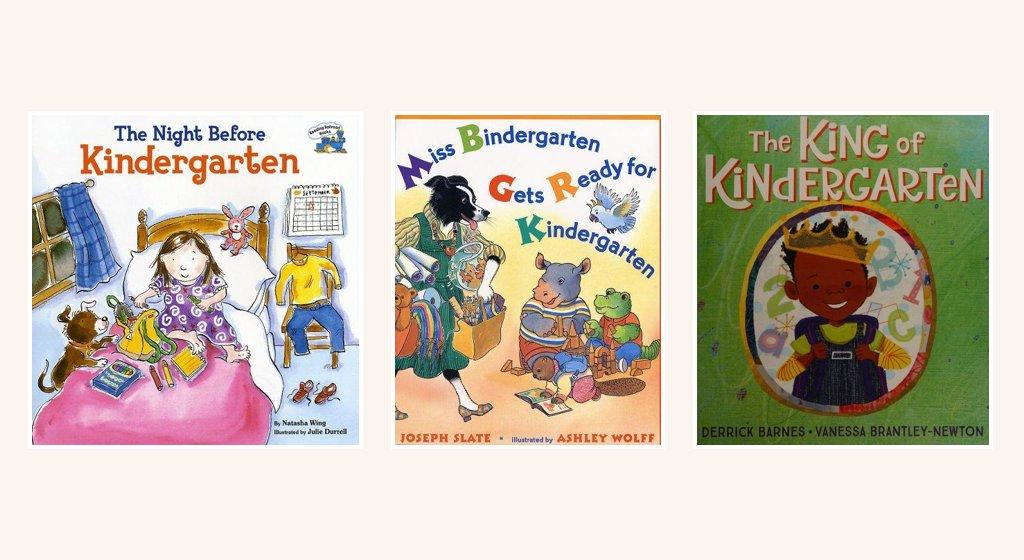
Same idea, bigger kid. “The Night Before Kindergarten” by Natasha Wing (ages 3–5) walks through packing the backpack, the photos, and the goodbye in the same soothing rhyme as its preschool sibling — a New York Times bestseller for a reason. “Miss Bindergarten Gets Ready for Kindergarten” by Joseph Slate (ages 4–8) flips the lens: the teacher is racing to get the classroom ready for them — school becomes a place that’s expecting you. And “The King of Kindergarten” by Derrick Barnes (ages 3–6) skips the jitters entirely: a mother’s words — you’ll be the King of Kindergarten — become the child’s inner script for the whole day (hear Terry Crews read it on Storyline Online). [19, 20, 21, 22]
The one where the hero is your child
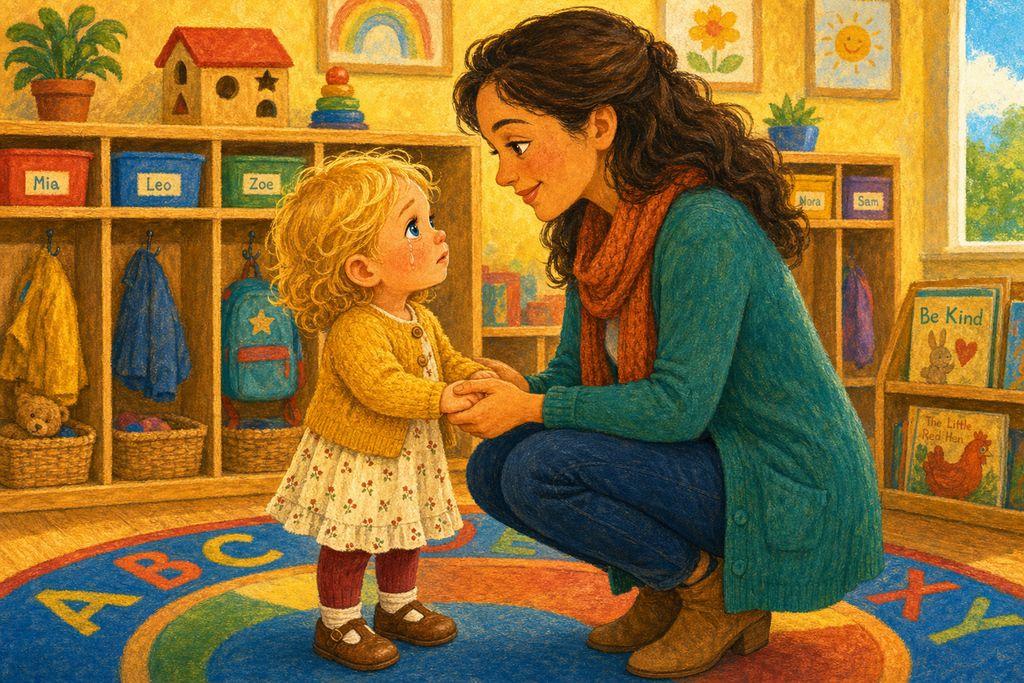
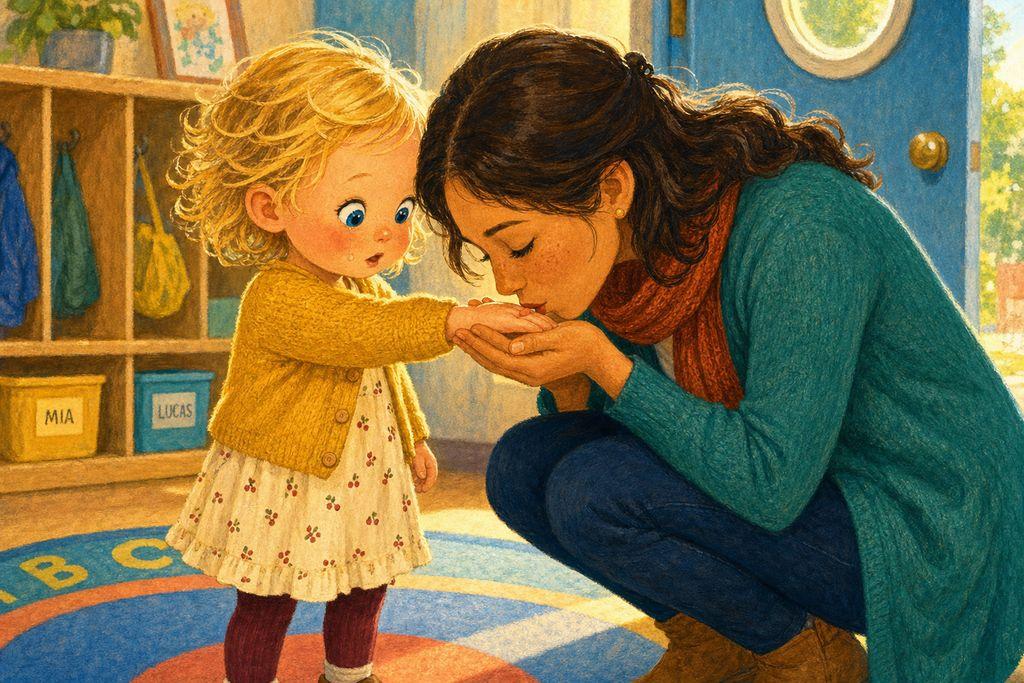
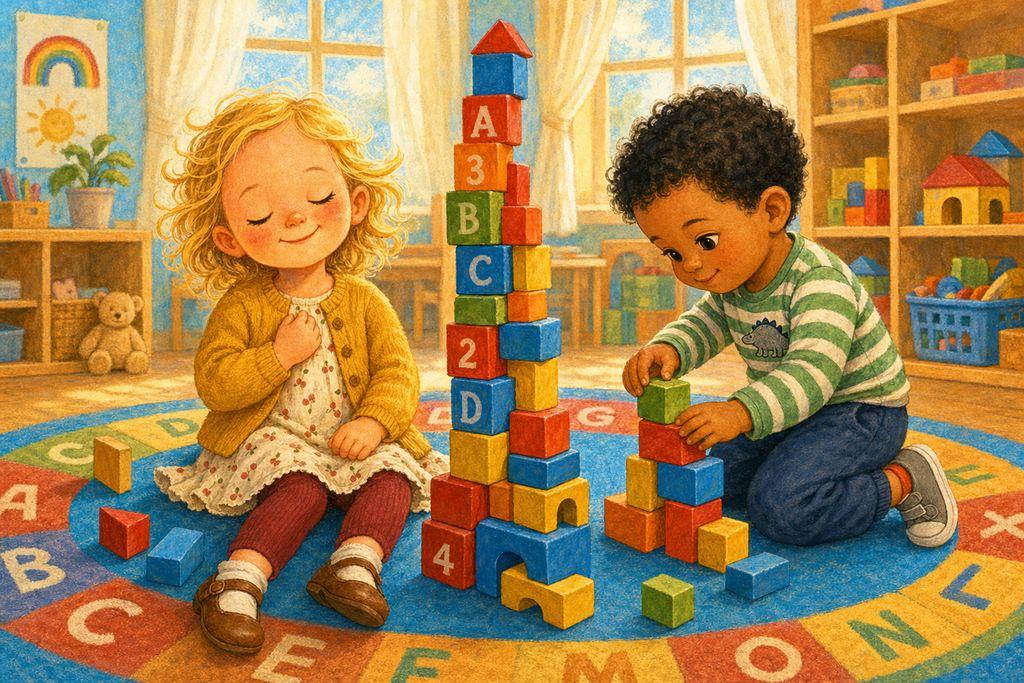
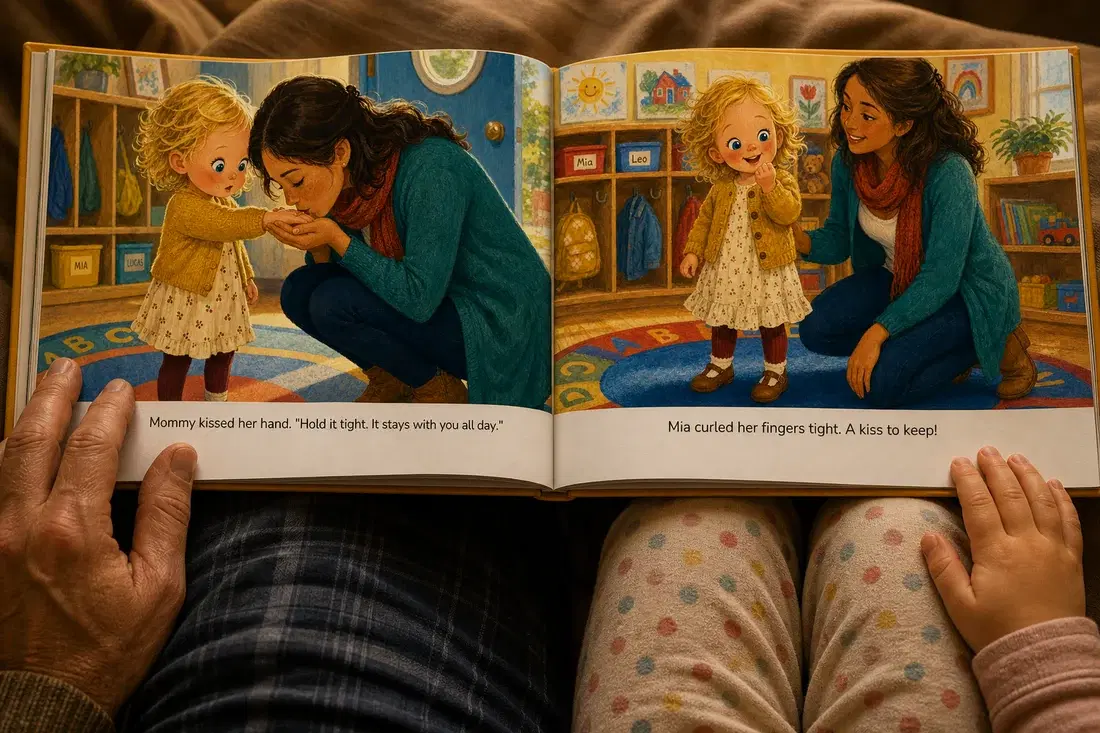
Notice what every book on this list is really doing: handing your child a coping model — someone who feels the scary thing and comes out okay. Chester has his kissing hand; Llama Llama makes it to pick-up; the owl mother comes back. A personalized storybook takes that same rehearsal one step further: the character who feels the wobble, holds the kiss, and makes it to the reunion is your child — name, face, their own cubby. “That raccoon was brave” becomes “I am brave.” There’s research behind the warmth, too: families share more smiles, more laughter, and more talk over a book made for the child than a generic one. Read it the same way the experts say to read all of these — early, together, talking about the feelings — and the first morning arrives already familiar. [1, 23]
What the personalized one looks like — “Mia’s Kiss to Keep”
Quick answers
When should we start reading first-day-of-preschool books?
In the weeks before school starts — not the night after a hard drop-off. Experts suggest choosing several and sharing them over the summer, so the rehearsal happens while things are calm and the story has time to sink in through re-reads.
How do I read them so they actually help?
Talk, don’t just read. Pause on the characters’ faces and name what they’re feeling (“Llama Llama looks worried — he misses his mama”), then ask how your child is feeling about their own first day. The conversation the book starts is the part that does the work.
Which book is best for starting kindergarten rather than preschool?
“The Night Before Kindergarten,” “Miss Bindergarten Gets Ready for Kindergarten,” and “The King of Kindergarten” are the age-right picks — the first for the night-before ritual, the second for making the classroom feel welcoming, the third for walking in confident.
What if the book seems to make the worry bigger?
Pause it and follow your child’s lead. For some kids a worry-focused book right before bed stirs things up — switch to an excitement-builder like “Maisy Goes to Preschool,” read earlier in the day, and let them ask questions at their own pace. The goal is familiarity, not exposure therapy.
Is a personalized first-day book actually better than the classics?
Different job, honestly. The classics are wonderful shared rehearsals — and a personalized book makes the rehearsal personal: the child watching themselves be brave. Families in one study shared more smiles and laughter over personalized books; the classics on this list plus one story starring your child is the combination we’d pick.
Who’s behind this
I’m Dao — a mom, and the founder of PlotJoys. I make personalized storybooks where your child is the hero, because the first-day books that work all share one trick — a character who’s scared and brave at the same time — and the strongest version of that character is your own kid. The classics taught us the ritual; we make the one where your child is holding the kiss.
Tell us the moment in a sentence or two, add a photo, and see them drawn as the hero.
Keep reading
The research, if you want it
- Zero to Three — “Preschool Prep: Helping Toddlers Prepare for Preschool”
- Nemours KidsHealth — “Reading Books to Preschoolers”
- American Academy of Pediatrics, HealthyChildren.org — “Preparing Your Child for Child Care”
- Tanglewood Books — “The Kissing Hand” by Audrey Penn (publisher page)
- PBS Reading Explorers — “The Kissing Hand” read-aloud
- Penguin Random House — “Llama Llama Misses Mama” by Anna Dewdney (publisher page)
- Vanderbilt CSEFEL — “Llama Llama Misses Mama” Book Nook teaching guide
- Penguin Random House — “The Night Before Preschool” by Natasha Wing (publisher page)
- Toledo Lucas County Public Library — “Owl Babies” by Martin Waddell (catalog record)
- Association of Child Psychotherapists — “Owl Babies” recommendation
- Kirkus Reviews — “Wemberly Worried” by Kevin Henkes
- American Library Association — “Wemberly Worried,” Notable Children’s Book (2001)
- Hachette Book Group — “The Invisible String” by Patrice Karst (publisher page)
- Penguin Random House — “Maisy Goes to Preschool” by Lucy Cousins (publisher page)
- Simon & Schuster — “Daniel Goes to School” (Daniel Tiger’s Neighborhood, adapted by Becky Friedman)
- Kirkus Reviews — “School’s First Day of School” by Adam Rex
- Reading Rockets — “School’s First Day of School” (book profile)
- Penguin Random House — “The Night Before Kindergarten” by Natasha Wing (publisher page)
- Penguin Random House — “Miss Bindergarten Gets Ready for Kindergarten” by Joseph Slate (publisher page)
- Penguin Random House — “The King of Kindergarten” by Derrick Barnes (publisher page)
- Storyline Online (SAG-AFTRA Foundation) — “The King of Kindergarten” read by Terry Crews
- Kucirkova, Messer & Whitelock (2013) — personalization and book engagement, Journal of Early Childhood Literacy