Daycare & Behavior
My Toddler Keeps Getting Bitten at Daycare — What to Do

By Dao, Founder · PhD in mathematics, former Director of Data Science at Uber and Capital One · LinkedIn ↗
The short version
- Your anger is protective instinct, not overreaction — and up to half of daycare toddlers get bitten, so you are not alone.
- At pickup, the order is comfort → get the facts → photo at home → practice later — not rage, not freeze.
- Teach your child the moves: a big “STOP — I don’t like that!”, step away, and tell a grown-up with real words (“A friend bit me — I need help”).
- With the school, accept “it’s normal” and ask for a specific plan — and know the real path if it doesn’t stop: director → state licensing → moving your child.
Your kid came home with a bite mark — or you watched another child shove them while the teacher called it “just a normal day” — and you’re furious. First, the relief: that anger isn’t an overreaction, it’s your protective instinct doing exactly what it’s built to do. And the harder truth to hold right next to it: at this age, hitting and biting are almost always big feelings outrunning words, not meanness — in fact up to half of daycare toddlers get bitten at some point, so your child isn’t a target and you’re not alone. What actually helps isn’t getting the other kid punished — and it’s not “hit them back.” It’s knowing what to do in the next fifteen minutes, giving your child a few simple moves, and knowing exactly how to work the school. Here’s all of it.
You’re not overreacting — and you’re not alone
Let’s start where the guilt usually creeps in. You are not being dramatic. The urge to protect your child from harm is wired into the oldest part of the parenting brain — a hair-trigger threat-detector built to keep a small, vulnerable human safe — so that surge of fury when you see a bite mark isn’t a character flaw, it’s the system working as designed. [1]
And you are in very good company. Research suggests up to half of toddlers in daycare get bitten at some point. It is one of the most common things that happens in a room full of little kids who don’t yet have the words for big feelings — which means your child isn’t being singled out, and you haven’t failed to prepare them. Two things can be true at once: this is normal, and it still deserves a real response. The rest of this is how to get one. [4]
First, the next fifteen minutes (at pickup)
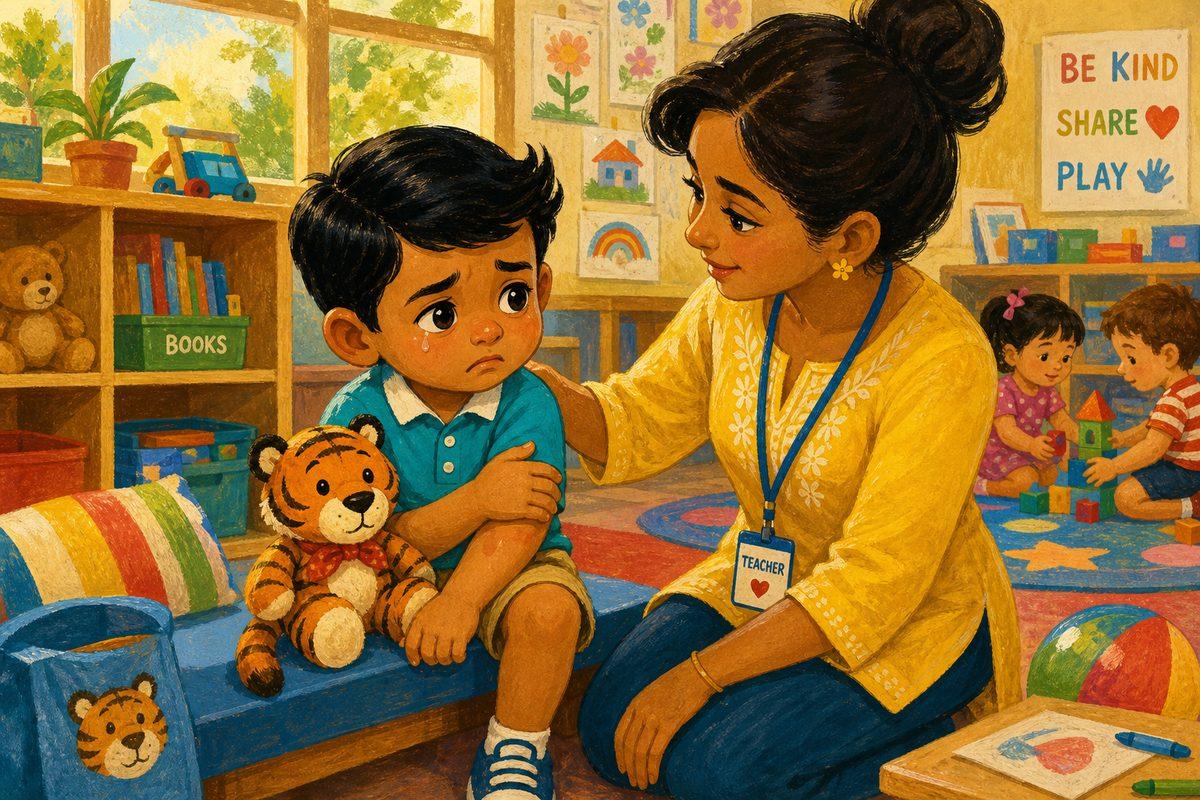
When you spot the mark and the heat rises, the most useful thing you can have is an order to follow, so you don’t freeze or say something you’ll regret. Here it is. First: your child, not the teacher. Get down to their level, hold them, let them feel safe — little kids read your face, so your calm becomes theirs. Name it simply (“that hurt — you’re sad, and a little mad”). The lesson can wait; right now they just need you. [8]
Then, while you’re still there, get the facts — kindly, not as an accusation: when did it happen, what was going on right before, and did a staff member see it? You want the timing and the trigger, not the other child’s name. Later, once everyone’s settled at home, take a quick photo of any mark — you’re not being dramatic, you’re keeping a simple record — and only then, gently, walk through the moves below. That’s the whole rhythm: you’ve comforted your kid, you’ve got the facts for any conversation with the director, and you taught instead of raged.
There are three people in this room
The reason this gets so painful — and so easy to mishandle — is that it’s really a triangle. There’s you (frightened, protective, a little enraged). There’s the other child’s parent (very likely mortified, dreading pickup, terrified their kid is “the bad one”). And there’s the school (caught in the middle, and bound by rules about what they can tell you). Picturing all three corners isn’t about going easy on anyone — it’s the thing that keeps this from turning into a war you can’t win. (And if you’re reading this from the other corner — your child is the one who bit — you’re not raising a bad kid either; that’s a companion piece, and the shame you’re carrying is just as misplaced.)
It helps to know the truth about that other corner: at this age, biting and hitting peak around two, when feelings are enormous and language and impulse control simply aren’t built yet. The child who bit yours is almost certainly not malicious and not “a bully” — they’re a toddler who ran out of words. That’s not an excuse, and it doesn’t make your kid’s hurt any smaller. It just points your energy at the things that actually work (the moves, and the school) instead of the thing that doesn’t (the other family). [2, 3]
Teach your child the “big voice”
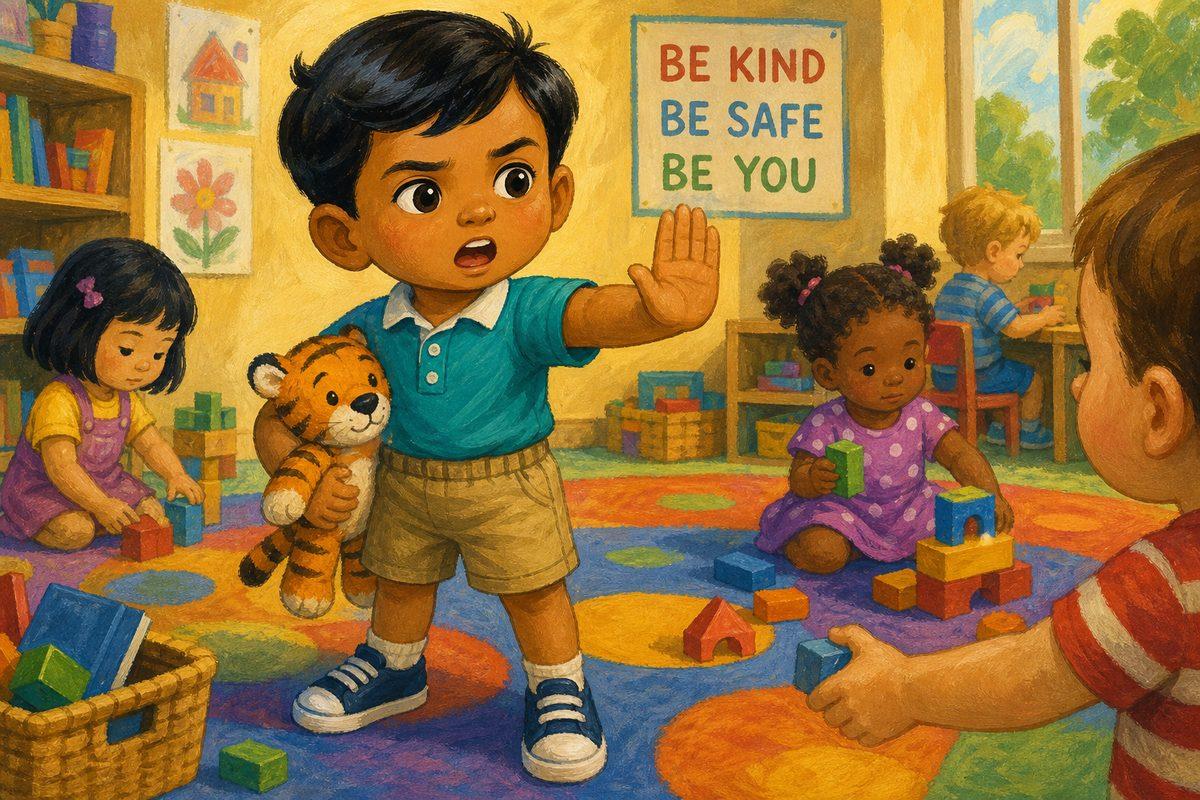
Here’s the most empowering shift: the lever you fully control isn’t the other kid — it’s handing your child a few simple moves. One: a big STOP. Loud and clear — “STOP! I don’t like that!” — with a flat stop-hand. Two: move away. Step back, get out of reach. Three: tell a grown-up, with real words ready to go: “A friend bit me — I need help.” A panicked two-year-old won’t invent that sentence in the moment, so you hand it to them in advance. And this is the one parents get wrong out of fear: telling is not tattling. Tattling is reporting something a child could handle alone; telling is alerting an adult that something is unsafe — exactly the case when someone is getting hurt. [5, 6]
What makes those moves stick is rehearsal when everyone’s calm — and it can be a game. Here’s how: you play the kid who bumps into them; they practice the big STOP and the step-back; do it three times, laughing, so the words are in their body before they ever need them. Then trade — let them feel what a firm “stop” sounds like. The move you do not teach is hitting back: it’s the gut instinct, but it escalates, blurs the very no-hitting rule you’re building, and a smaller kid usually loses anyway. Strong isn’t hitting back — strong is the big voice and getting help. (For the fuller playbook on managing the big feelings underneath all of this, see our guide to gentle hands.) [7, 8]
What your child can actually do, by age
Match your expectations to the brain in front of you. Under 2: the protecting is yours — they can’t self-advocate yet, so close supervision (theirs and yours) is the whole strategy. 2–3: the very first “STOP!” and a stomp away become possible; keep it to one or two words. 3–4: this is where “go tell the teacher” really lands, as language and the idea of fairness click into place. 4–5: they can start narrating it (“he grabbed it and I said stop”) and seeking help on their own. None of this is a should — every kid arrives at these on their own clock, and a 2½-year-old who can’t do any of them yet is not behind. It’s the same developmental curve that makes the biting fade, too: as words arrive, the hands and teeth quiet down. [2, 5]
When the school says “it’s normal” and moves on
Here’s what’s maddening about that moment: the teacher isn’t wrong. Biting really is developmentally normal — but “normal” describes why it happened; it is not a response to it. A good program knows the difference: early-childhood educators are explicit that biting is typical and something to actively guide, not to shrug at and not to punish the child for. So you don’t have to choose between “overreacting” and “letting it go.” You get to accept the “it’s normal” and ask for a plan. [9]
And a real plan isn’t a punishment plan — there’s no villain to punish. It’s prevention + teaching. So make the ask specific, not vague — ask the director: (1) When did it happen and what was the trigger? (2) How will you change the room or the timing to head it off? (3) What one word or move are you teaching the child instead? (4) Can I get that in writing, with a date we’ll check back — say a week? That’s what a real plan looks like: specifics, not reassurance. Two more concrete moves: ask to see the incident report the center filed (most states require one for an injury — a good center hands it over, and a hesitation is itself a signal), and know that if they won’t give you even the basics — the when, the trigger, what they did — that’s a red flag in its own right. One honest boundary, though: you can see the safety side of all this, but you usually can’t see the other child’s individual plan. So the frame is “what are you changing to keep my kid safe,” not “show me their plan.” [9]
Why they won’t tell you which kid did it
Almost every parent assumes this is FERPA — the school-privacy law. Here’s the myth-bust: FERPA usually doesn’t even apply to daycares. It only covers programs that receive U.S. Department of Education funding, and most licensed daycares and preschools don’t (even Head Start runs on different, non-Education money). So “it’s FERPA” is, more often than not, simply wrong. [10, 11]
The real reason is usually your state’s child-care licensing rules, which commonly make a child’s identifying information confidential and limit who can see a child’s records to the licensing department, the child’s own caregivers, and that child’s own parent — and another family just isn’t on that list. (The exact rule varies by state; some even print it on the incident form.) And here’s the reframe that should lower your blood pressure: that same rule protects every child — including the one who bit — from being named and shamed. The privacy that keeps the other kid’s name from you is the privacy that keeps your kid’s name off the gossip chain the day it’s the other way around. Everybody’s child gets it. [12, 13]
When to escalate — and when to walk
If it keeps happening, there’s a real ladder. Teacher → director (go straight to the director when it’s serious or repeating; ask for the plan in writing, with a timeline, and document each incident — date, what happened, any marks). And past the center there’s a genuine third party most parents don’t know they have: your state’s child-care licensing agency. Every state has one — it sets and enforces the safety rules a program must meet to legally operate, and any parent can file a complaint about supervision or safety. They investigate, sometimes with an unannounced visit, and post findings publicly. (A licensing agency regulates; a child-care resource & referral line only helps you find care — useful, but it can’t discipline anyone.) [18, 19]
And yes — can the biting child be expelled? It happens, and more than you’d think: preschoolers are dismissed at three times the K-12 rate, and private daycare expels at more than thirteen times that rate. But it’s framed as a last resort — the AAP is formally worried about how readily young kids are pushed out, and several states now restrict it. The honest bottom line on leaving: weigh it on supervision and ratios, not one bad day. If a room is chronically understaffed, kids are left unwatched, or the center discourages you from dropping in unannounced, the conditions that produce repeated injuries are baked in — and the clearest signal of all is how the program responds to your concern. A good one takes your line seriously. The version of “never see that kid again” you actually control isn’t getting them expelled — it’s moving your own child to a room, or a center, that can keep them safe. [14, 15, 16, 17, 20, 21, 22]
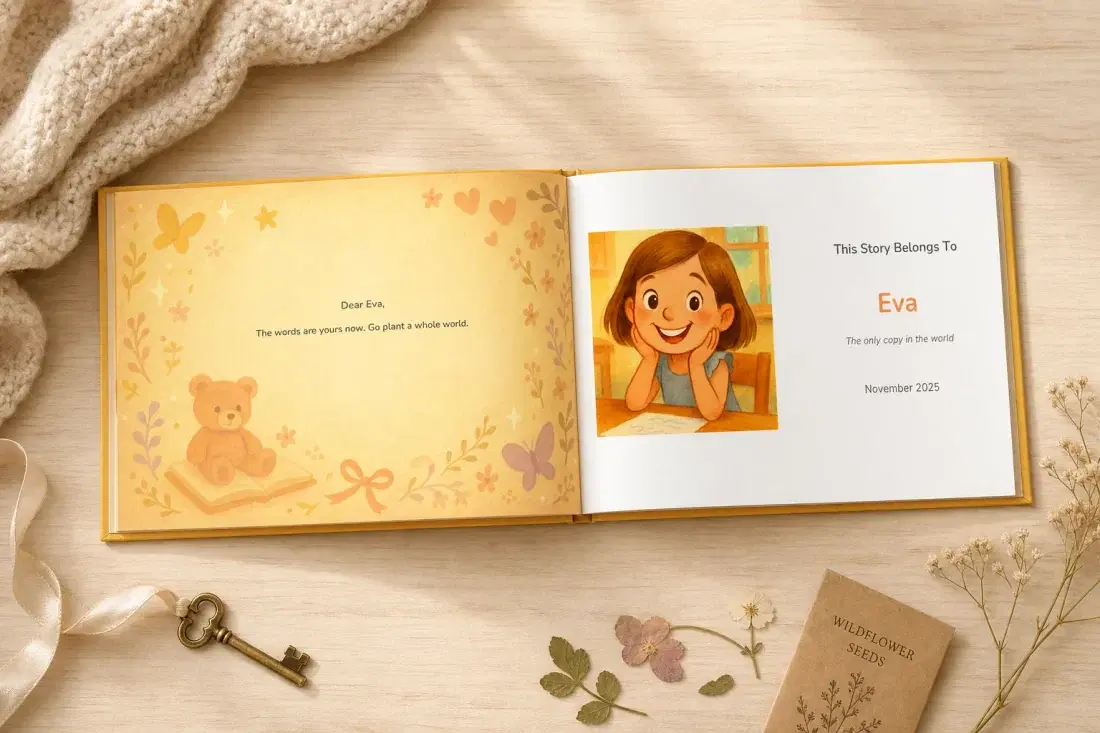
See the “find your voice” story — starring your child

Quick answers
Can the daycare tell me which child bit mine?
Usually no — and it’s almost never staff being cagey. In most states, child-care licensing rules keep every child’s information confidential and limit who can access a child’s records to the center, the licensing department, and that child’s own parents. It’s typically a state licensing rule (not FERPA, which usually doesn’t apply to daycares), and the same rule keeps your child’s name private, too.
Should I teach my kid to hit back?
It’s the gut instinct, but no — it escalates, it confuses the no-hitting rule you’re teaching, and a smaller child usually loses the exchange anyway. The stronger move is a big “STOP, I don’t like that,” stepping away, and telling a grown-up. Strong isn’t hitting back; it’s the big voice and getting help.
What should I do at pickup when I see the bite mark?
In order: comfort your child first (your calm becomes theirs), then — while you’re still there — ask the teacher when it happened and what the trigger was, then at home take a quick photo of any mark and gently practice the “say STOP and tell a grown-up” moves. Comfort, facts, record, teach — in that order.
When should I pull my child out?
Not over one incident. Weigh it on supervision and ratios over time — chronic understaffing, kids left unwatched, a center that won’t let you drop in unannounced, or repeated injuries with no real change after you’ve asked for a plan. The clearest signal is how seriously the program takes your concern.
Who’s behind this
I’m Dao — a mom, and the founder of PlotJoys. I started making personalized storybooks because when something hard is happening to your child, the most powerful thing you can hand them is a version of themselves getting through it — a hero who looks like them, finding their voice. And whichever side of this you’re on — the child getting hurt, or the one who bit — you’re in a very normal, very painful moment, your child is not the bad one, and you’re not failing. I’m glad you’re here.
Tell us the moment in a sentence or two, add a photo, and see them drawn as the hero.
Keep reading
The research, if you want it
- Kohl et al. — “Exploring the neural basis for paternal protection: an investigation of the neural response to infants in danger” (PMC / NIH)
- ZERO TO THREE — “Aggressive Behavior in Toddlers”
- American Academy of Pediatrics, HealthyChildren.org — “Emotional Development: 2 Year Olds”
- ZERO TO THREE — “Why do toddlers bite?”
- American Academy of Pediatrics, HealthyChildren.org — “10 Tips to Prevent Aggressive Behavior in Young Children”
- Child Mind Institute — “Is It Tattling or Telling?”
- Child Mind Institute — “How to Arm Your Child Against Bullying” (rehearsing responses)
- ZERO TO THREE — “How to Foster Resilience in Infants and Toddlers”
- NAEYC — “Understanding and Responding to Children Who Bite”
- continued.com — “Family Educational Rights and Privacy Act (FERPA) for Early Childhood Providers”
- U.S. Department of Education — “To which educational agencies or institutions does FERPA apply?”
- South Carolina DSS — “Regulations for the Licensing of Child Care Centers” (Reg 114-503, confidentiality of child records)
- New York State Office of Children & Family Services — Incident Report for Child Day Care (Form OCFS-4436)
- Preventing Suspensions and Expulsions in Early Childhood Settings — “Overview of the Issue” (3× / 13× expulsion rates)
- Yale News — “Pre-K Students Expelled at More Than Three Times the Rate of K-12 Students” (Gilliam, Yale Child Study Center)
- American Academy of Pediatrics, HealthyChildren.org — “Preventing Preschool Expulsions: AAP Policy Explained”
- New America — “Ban Suspension and Expulsion in ECE, Then Provide Additional Behavior Supports”
- Childcare.gov (HHS Office of Child Care) — “Report a Child Care Concern”
- Childcare.gov (HHS Office of Child Care) — “What Is Child Care Licensing?”
- Child Care Aware of America — “Child Care Center Checklist” (supervision + open-door visitation as quality markers)
- ZERO TO THREE — “Child Care: Ratios and Group Sizes Matter”
- American Academy of Pediatrics, HealthyChildren.org — “Why Quality Matters in Early Child Care & Preschool”